

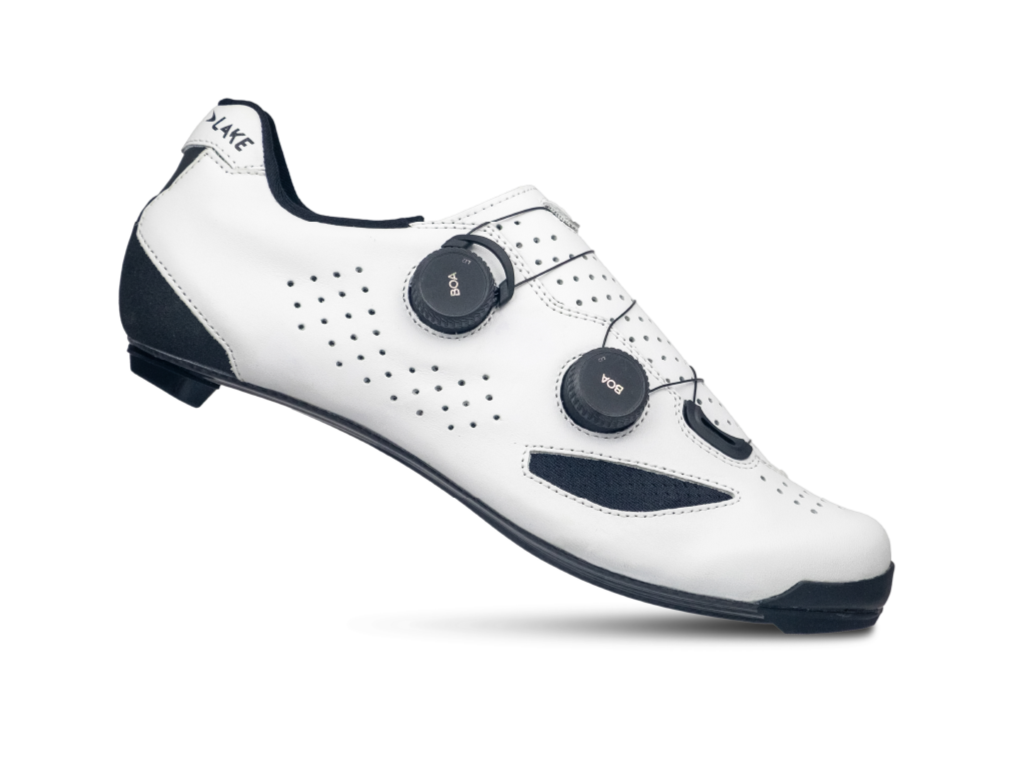
Cycling shoes should fit snug but not tight. Your heel stays put when you pull up on the pedal, your longest toe comes close to the front without touching it, your toes can still wiggle, and nothing presses on the top or sides of your foot. Measure length and width at home, then match both to our size guide.
A cycling shoe is not a sneaker. It has a stiff sole, holds your foot in one position for hours and carries every pedal stroke, so a few millimeters matter. Too short and your toenails suffer; too roomy at the heel and your foot slides on every upstroke.
We have made cycling shoes since 1982, and this guide sticks to one question: how to get your size and fit right. Still choosing between road, MTB or gravel? Start with our complete guide to choosing cycling shoes.
How to measure your feet at home
You need a sheet of paper, a pencil, a ruler or tape measure, a wall, and the socks you ride in. It takes five minutes.
- Measure later in the day. Feet swell a little through the day, just as they do on the bike, so an afternoon measurement is closer to how they feel on a long ride.
- Stand, do not sit. Put the paper on a hard floor against the wall and stand on it, heel touching the wall, full weight on that foot. A loaded foot is longer and wider than a resting one.
- Mark the tip of your longest toe, with the pencil held upright. Your longest toe is not always your big toe.
- Measure the length in centimeters, from the wall to the mark.
- Measure the width across the widest part of your forefoot, the ball of the foot just behind the toes.
- Repeat for the other foot, twice each. Most people have one foot slightly larger than the other: you fit the larger foot.
Our page on how to measure your foot for Lake cycling shoes walks you through the same steps.
What the two numbers tell you
Length sets your size. Width tells you which width option to choose and helps you pick the right last. Lake shoes are sized in EU sizes, and our size guide turns your measurements into a Lake size.
Measure even if you think you know your size. Sizes are not standardized between makers, and a measurement in centimeters is more reliable than any size label.
How a cycling shoe should feel
Put both shoes on in your riding socks, close them, and stand up. Then check four zones, from the back to the front.
Heel: locked in, not crushed
Your heel should sit deep in the heel cup and stay there when you lift your foot as if pulling up on the pedal. On a stiff sole, a little movement when you walk is normal. Real heel lift, your heel sliding up and down inside the shoe, is not. It means the heel cup or the whole shoe is too big for your foot, and it costs you stability on every pedal stroke.
Toes: close to the front, free to move
Lean forward onto the balls of your feet, the way you push down on the pedal. Your longest toe should come close to the front of the shoe without pressing against it. With the shoe closed, you should be able to lift and spread your toes.
A cycling shoe fits closer at the front than a running shoe, because your foot does not roll forward with every step, so you do not need a thumb's width of room. Your toes should never be curled or pushed together, though. For more on why toes need space, read our guide to wide toe box cycling shoes.
Midfoot and instep: held, without pressure points
The shoe should wrap the middle of your foot evenly, like a firm handshake, with no hard spot on top of the foot, on the little toe or on the big toe joint. If the top of your foot aches, the shoe lacks volume over your instep. Tightening the closure will only make that worse.
How tight should cycling shoes be?
Snugger than a walking shoe, so your foot cannot move on the stiff sole, but never so tight that something squeezes. Close the dials, laces or straps until your heel stays put, then stop. If you have to crank them down, the shoe is too big or the wrong shape. The best test: after an hour of riding, you should not be thinking about your feet at all.
Trying shoes on at home only tells you about the first few minutes. Feet spread under pedaling pressure and swell with effort, so if you can, ride new shoes on an indoor trainer for a long session first. After 90 minutes there should be no numbness, no burning and no hot spots.
Length and width are two separate choices
The most common sizing mistake we see: a rider whose shoes pinch across the forefoot orders a size up. The longer shoe is hardly wider at the toes, the heel ends up loose, and the foot slides forward. Keep the length you measured, and change the width or the last instead.
Our widths
- Narrow is for slim, low-volume feet. You find it on the CX333, CX302 and CX20R for the road, the MX333, MX30G and MX20G off-road, and the TX224 for triathlon.
- Regular is our standard width.
- Wide is available on most of our road, MTB, gravel and winter models, for example the CX239 Wide and the MX333 Wide.
Not every model comes in every width. The CX201, MX201, MX169 and MXZ305 are Regular only. The first three are built on our Comfort Plus Last, the widest toe box we make, so their Regular already gives a lot of room.
Our lasts
The last is the foot-shaped form a shoe is built around. It sets the shape of the toe box, the heel cup and the volume.
- Race Last: a narrower toe box and a tight heel cup, for a secure, race-oriented hold. CX403, CX333, CX302, MX333.
- Competition Last: a larger toe box with a tight heel cup. The fit that suits most riders. CX239, CX242, MX239.
- Sport and Sport Comfort Last: a balanced, everyday fit. The Sport Comfort Last on the CX178 and MX178 has a broader toe box.
- Comfort Plus Last: our widest toe box and most foot-shaped fit. CX201, MX201, MX169.
Our fit matrix shows which last every model uses. For the full story on our widest last, read foot-shaped cycling shoes and the Comfort Plus Last. If you have wide feet, our guide to cycling shoes for wide feet goes deeper.
Half sizes and falling between sizes
Most of our road, MTB, gravel and triathlon shoes come in half sizes through the middle of the range, from 39.5 to 46.5, and several models start their half sizes at 37.5. Our winter shoes (CX146, MX146, MXZ21 and MXZ305) and a few everyday models such as the CX178, MX177 and MX178 come in whole sizes only. The size selector on each product page shows exactly which sizes a model comes in.
If your measurement falls between two sizes:
- The model comes in half sizes: take the half size that matches your measurement.
- The model comes in whole sizes only, or you sit between two half sizes: choose the larger size. A little extra length can be managed with a good heel hold and the closure. A shoe that is too short cannot be fixed.
- Your feet are different sizes: fit the larger foot. A heat-moldable heel counter can take up space around the smaller heel.
Signs your cycling shoes do not fit
Most fit problems show up after 30 to 60 minutes of riding. Here is what they usually mean.
| What you feel | What it usually means | What to try |
|---|---|---|
| Numb or tingling toes | Too narrow across the forefoot, or the closure is too tight | Loosen the closure first. If it comes back, try a Wide version or a broader last |
| Hot foot (burning under the ball of the foot) | Too narrow, closure too tight, or cleat mounted too far forward | Loosen the closure, check your cleat position, then look at width |
| Heel lift on the upstroke | Heel cup too big, too much volume, or the shoe is too long | Check your length. Then try a narrower last or a heat-moldable heel |
| Sore or bruised toenails | Shoe too short, or the heel slides forward | Check your length and your heel hold |
| Ache on top of the foot | Too little volume over the instep, or closure too tight | Loosen the closure. If that does not help, try a different last |
| Pressure on the little toe or big toe joint | Toe box too tapered for your foot | Choose a broader last, such as Comfort Plus |
If numbness or pain keeps coming back after you change shoes, or lingers long after the ride, see a podiatrist or doctor. A better-fitting shoe can take pressure off your foot. It cannot tell you why your foot hurts.
When to size up: winter shoes and thick socks
There is one situation where we do recommend a bigger size. For use with winter-weight socks, we recommend ordering 1 to 1.5 sizes up from your usual Lake size. That is the sizing advice on our winter shoes, including the CX146, MX146, MXZ21 and MXZ305.
The extra room fits a thicker sock and leaves a layer of warm air around your foot. A winter shoe that squeezes feels colder, not warmer. If you ride your winter shoes with thinner socks, stay closer to your usual size.
Do not size up your summer shoes for winter socks: keep them precise and add overshoes, or switch to an insulated winter shoe. Our guide on how to keep your feet warm cycling covers socks, overshoes and layering.
How to use our size guide, Find My Fit and the fit matrix
Three tools take the guesswork out of ordering online. Use them in this order:
- Size guide. Compare your length and width with the size guide to find your Lake size.
- Find My Fit. Find My Fit asks for your measurements and your foot shape, then suggests the Lake models and widths that suit you. It is the quickest way to narrow the range down.
- Fit matrix. The fit matrix shows which last each model is built on. If a Lake shoe has fit you well before, it shows you its relatives on the same last.
Already ride a Lake shoe that fits perfectly? Then the shortest route to your next pair is the same size on the same last.
Frequently asked questions
How should cycling shoes fit?
Snug but not tight. Your heel stays put with minimal lift, your longest toe comes close to the front without pressing, and you can wiggle and spread your toes. The upper wraps your midfoot evenly without one hard spot. After 90 minutes of riding there should be no numbness, no burning and no hot spots.
How tight should cycling shoes be?
Tight enough that your foot cannot move on the sole and your heel stays in the cup, and no tighter. If you have to crank the closure down to stop your foot moving, the shoe is too big or the wrong shape. If you keep loosening it during a ride, it is too small or too narrow.
Should I size up in cycling shoes?
No, not for your road, MTB or gravel shoes. A bigger size makes the shoe longer but hardly wider, and your heel ends up loose. If the shoe pinches, choose a Wide version or a broader last instead. The exception is winter shoes, where we recommend 1 to 1.5 sizes up for winter-weight socks.
Do Lake cycling shoes come in half sizes?
Most of our road, MTB, gravel and triathlon shoes do, from 39.5 to 46.5, and several models from 37.5. Our winter shoes and a few everyday models, such as the CX178, MX177 and MX178, come in whole sizes only. The size selector on each product page shows the exact sizes for that model.
What if one foot is bigger than the other?
Fit the larger foot; most people have one foot slightly larger. On the smaller side, the closure takes up a little extra room, and on models with a heat-moldable heel counter the heel cup can be shaped to each foot separately.
Are Lake cycling shoes true to size?
Lake shoes are sized in EU sizes and run true to EU size. Even so, we recommend measuring your feet in centimeters and using our size guide rather than converting from your other shoes, because sizing differs between makers and shoe types.
Find your size
A cycling shoe that fits is one you forget about on the bike. Measure both feet this afternoon, check your numbers in our size guide, and let Find My Fit suggest the Lake models, widths and lasts that suit your feet. Still torn between two sizes or two lasts? Find My Fit is the place to settle it.
Women's Cycling Shoes: What Is Different and How to Choose