

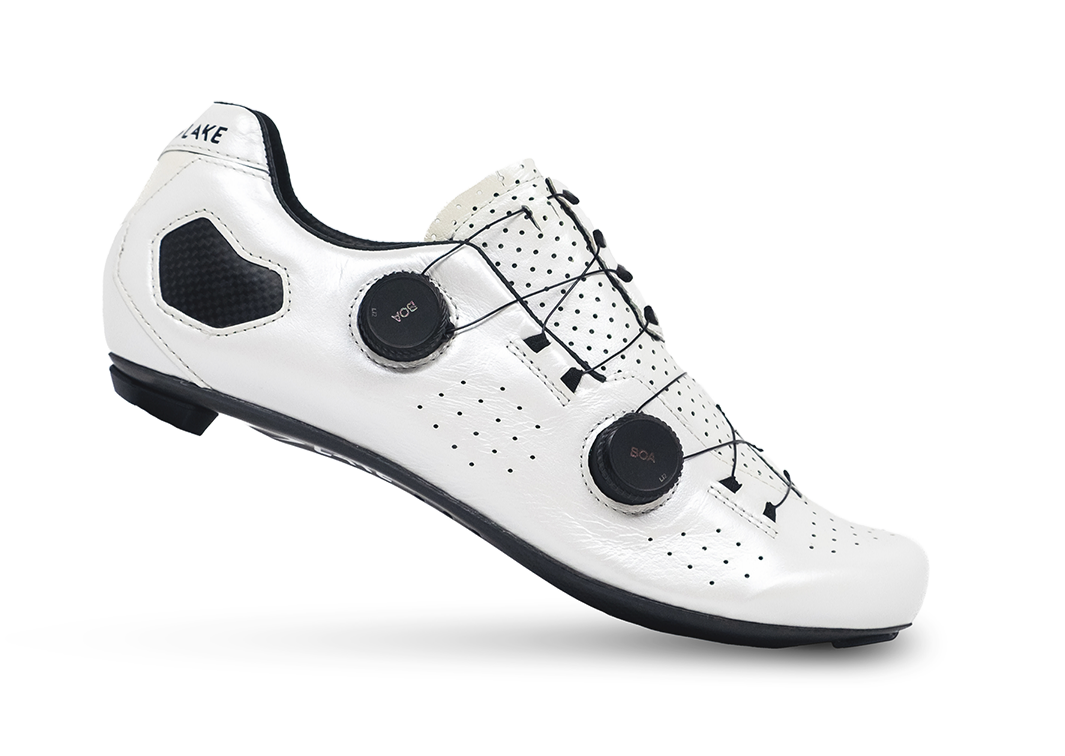
Heat moldable cycling shoes have a heel counter that softens when warmed, so it can be shaped around your own heel and then holds that shape as it cools. On Lake shoes it is the heel that is moldable, not the whole shoe. It fine-tunes heel hold; it does not replace choosing the right last and width.
Every foot is different at the back. Two riders can wear the same size and width and still have very different heels: one narrow and bony, one broad and rounded, one sitting slightly higher than the other. A stiff heel cup that suits the first rider can let the second one slip. That is the problem a heat-moldable heel counter is there to solve.
Below we explain what heat molding is, which part of a Lake shoe can be molded, who gets the most out of it, how the process works, what it can and cannot fix, and which Lake models have it.
What heat molding means on a cycling shoe
The heel counter is the stiff cup at the back of the shoe that wraps around your heel. Its job is to hold the rear of your foot still, so that the power you put into the pedal is not lost to movement inside the shoe.
On most cycling shoes that cup has one fixed shape. On a heat-moldable shoe, the heel counter is made from a material that becomes pliable when it is warmed. While it is soft, it can be shaped to follow the contours of your heel. Once it cools, it sets in that new shape and stays firm again.
You will also see it written as "heat mouldable" (the UK spelling) or "thermoformable". They all mean the same thing.
Which part of a Lake shoe is heat-moldable
On Lake shoes it is the heel counter that can be molded. On the CX333 and MX333 that is an internal Thermaform carbon fiber heel counter, combined with a Carbitex arch support panel. On the CX242 and MX242 it is a heat-moldable heel counter paired with a segmented upper built for hard-to-fit feet. The CX403, our flagship road shoe, has a heat-moldable heel as well.
The sole, the toe box and the width of the shoe are not changed by molding. Those are set by the last the shoe is built on, which is why the right last and width always come first. If you want to understand how lasts shape the fit, our guide to choosing cycling shoes for a perfect fit explains it in detail.
Not every Lake performance shoe is heat-moldable. The CX400 and CX400L, for example, cannot be heat molded: they use a different heel design that is ready to ride as it comes.
Who benefits from a heat-moldable heel
In our experience the riders who gain the most are the ones whose heel does not match the shape of a standard heel cup.
Riders with heel slip
If your heel lifts out of the cup on the upstroke, you lose stability and often end up over-tightening the closure to compensate. A molded heel counter follows the shape of your heel more closely, so it can hold the back of the foot more securely without extra pressure on top of the foot.
Wide feet with a narrow heel
This is one of the most common fit puzzles we see. You need a Wide shoe for your forefoot, but a Wide shoe can feel loose at the back. Choosing a wide version of a heat-moldable model, such as the CX333 Wide or CX403 Wide, solves the forefoot, and molding the heel then takes up the space around a narrow heel. Our guide to the best cycling shoes for wide feet covers the forefoot side of that story.
Asymmetric feet
Many riders have one foot slightly different from the other. Because each shoe is molded on its own foot, each heel counter takes the shape of the heel that is actually in it.
Bony or sensitive heels
A heel counter that follows your heel's contours spreads contact more evenly, which can help where a fixed cup presses on one spot. That makes molding useful for hot spots at the back of the foot.
A note on bunions: a bunion sits at the front of the foot, so molding the heel does not address it. For bunions and difficult forefoot shapes we point riders to the segmented upper of the CX242 and MX242, which flexes around pressure points and can be adjusted zone by zone.
How the molding process works
In general terms it is simple. The heel area of the shoe is warmed until the heel counter softens. You then put the shoe on, and the heel is shaped by hand around your heel while it cools and sets. The result is a heel cup that follows your foot rather than a generic one.
We do not publish temperatures or times for this, and we do not recommend improvising at home with a kitchen oven or a heat gun. Too much heat in the wrong place can damage the shoe. Ask your Lake dealer whether they can mold the heel for you, or contact us and we will advise you on the best way to do it where you live.
Before any molding, make sure the shoe is the right size and width. Check your length with our sizing chart first.
What heat molding can and cannot fix
Heat molding is fine-tuning. It works on the shape of the heel cup and nothing else.
What it can do:
- Give a closer, more secure hold around your heel
- Reduce heel lift on the upstroke
- Take up space around a narrow heel in a Wide shoe
- Match each shoe to each foot when your heels differ
What it cannot do:
- Make a shoe longer or shorter. If the size is wrong, molding will not save it.
- Make a narrow shoe wide. Forefoot width comes from the last.
- Fix toe box pressure or a bunion. Those are forefoot issues.
- Change the stiffness of the sole.
That is why we always start with the last and the width. Get those right, and a molded heel takes a good fit and makes it yours. Start with the wrong shoe, and no amount of molding will make it comfortable.
Lake heat-moldable cycling shoes
These are the current Lake models with a heat-moldable heel. All five use dual BOA Li2 closure.
| Model | Discipline | Last | Heel | Widths available |
|---|---|---|---|---|
| CX403 | Road | Race Last | Heat-moldable heel | Regular, Wide |
| CX333 | Road | Race Last | Thermaform carbon fiber heel counter | Narrow, Regular, Wide |
| CX242 | Road | Competition Last | Heat-moldable heel counter | Regular, Wide |
| MX333 | MTB and gravel | Race Last | Thermaform carbon fiber heel counter | Narrow, Regular, Wide |
| MX242 | MTB | Competition Last | Heat-moldable heel counter | Regular, Wide |
The CX333 and CX403 also come in a women's version, and the women's CX333 is built with a narrower heel.
Which one for you? If you race on the road and want the widest choice of widths, the CX333 is the natural start. For racing off-road, the MX333 brings the same Thermaform heel counter to the trail. If your feet are hard to fit, with bunions or an unusual shape, look at the CX242 and MX242 first.
Frequently asked questions
What does heat moldable mean on a cycling shoe?
It means part of the shoe softens when warmed and can be shaped to your foot, then holds that shape once it cools. On Lake shoes that part is the heel counter, the stiff cup around your heel. Molding it gives a closer, more personal heel hold.
Which Lake cycling shoes are heat moldable?
The CX403, CX333 and CX242 for road, and the MX333 and MX242 for mountain bike and gravel. The CX333 and MX333 use an internal Thermaform carbon fiber heel counter. Not every Lake shoe has it: the CX400 and CX400L cannot be heat molded.
Can I heat mold my cycling shoes at home?
We do not recommend it. Uncontrolled heat from an oven or heat gun can damage the shoe, and shaping the heel well takes experience. Ask your Lake dealer whether they can do it for you, or contact us and we will advise you on the best option.
Will heat molding make my cycling shoes wider?
No. Molding shapes the heel counter only. The width of the forefoot and the shape of the toe box come from the last the shoe is built on. If a shoe is too narrow, choose a wider version or a different last rather than relying on molding.
Do I have to heat mold a new Lake shoe?
Not necessarily. Many riders get a secure heel from the right last and width alone. Molding is there for when your heel still slips or does not sit right, for example a narrow heel in a Wide shoe, or two feet that differ.
Find your fit first, then fine-tune
A heat-moldable heel is one of the ways we make a shoe truly personal, but it works best on a shoe that already fits. Choose the right last and width, check your size, and then let a molded heel counter lock in the details. If you are unsure where to start, contact us and tell us about your feet. After more than 40 years of making cycling shoes, fitting feet like yours is what we do.
How to Keep Your Feet Warm Cycling in Cold Weather
Winter Cycling Shoes: Getting to the soul of cycling shoe design