

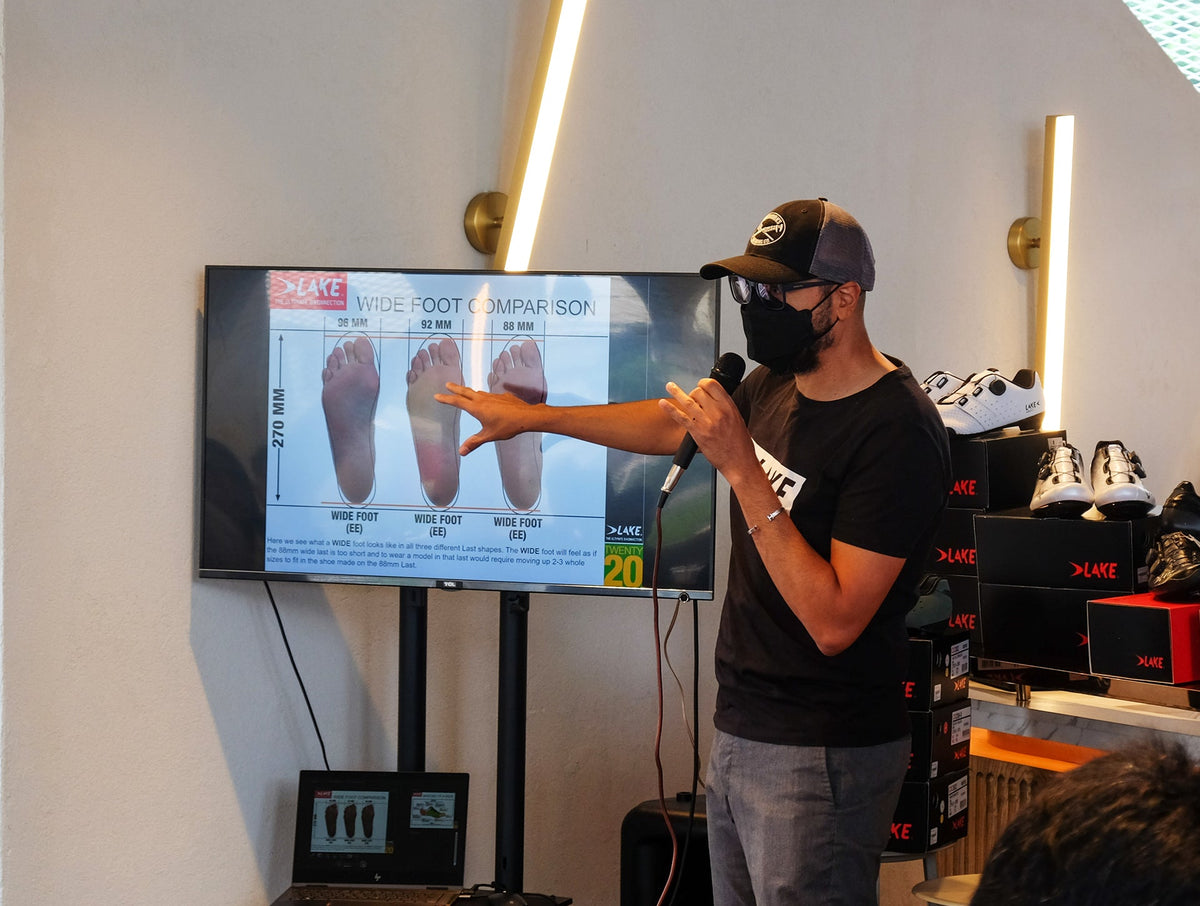
Wide toe box cycling shoes give your toes room to spread as you push on the pedals and as your feet swell over a long ride. If your toes go numb, tingle or burn under the ball of the foot, the toe box is usually too narrow or too shallow. The fix is a broader last, such as our Comfort Plus Last, not a bigger size.
We have made cycling shoes since 1982, and the complaint we hear most in the fitting room is about toes: numb after half an hour, burning on every climb. Most riders blame their feet. Almost always, it is the shape of the shoe.
This guide explains why toes need room on the bike, how to spot a cramped toe box, and how toe box shape, width and volume differ. If you already know you need more space, our wide toe box cycling shoes are all in one place.
Why your toes need room on the bike
At a cadence of 90, each foot presses the pedal 5,400 times an hour, always on the same small area. Two things happen to your forefoot during that work, and both need space.
Your forefoot spreads under load
Your feet get wider the moment they carry weight, and every pedal downstroke loads the ball of the foot. The forefoot spreads to share the pressure and the toes splay to keep the foot stable over the pedal. That is how your foot is meant to work.
If the toe box narrows too quickly in front of the ball of the foot, the spreading forefoot meets the side walls of the shoe and the toes get pushed together. A shoe that felt fine while you sat in it starts to pinch.
Your feet swell on long rides
Heat, effort and hours in the same position make most feet swell a little, and the effect builds on long days. A shoe that fits at the start of a century can feel tight by mile 70. That is why we tell riders to measure their feet later in the day and to judge a shoe on a long ride. A toe box with some room absorbs the swelling. One that is full at the start cannot.
Signs your toe box is too tight
The symptoms usually build during the ride, often after 30 to 60 minutes:
- Numb or tingling toes that fade once the shoes are off.
- Burning under the ball of the foot, the feeling riders call hot foot.
- Hot spots on the little toe or the big toe joint.
- Red pressure lines along the outside of the forefoot after the ride.
- Loosening the dials again and again without it ever feeling right.
When it is not the toe box
Rule out the easy fixes first:
- Hot foot can also come from a closure that is too tight, or from cleats mounted too far forward.
- Pressure on top of the foot points to too little volume over your instep, not too little width.
- Sore toenails mean your toes are hitting the front. Check the length, and check that your heel is not sliding forward.
- Heel slip is a heel cup or volume issue. A wider toe box will not fix it.
If numbness or pain keeps coming back after you change shoes, or lingers long after the ride, see a podiatrist or doctor. A better-fitting shoe can take pressure off your foot. It cannot tell you why your foot hurts.
Toe box shape, width and volume are not the same thing
When riders say a shoe is "too narrow", they can mean three different things, and each one has a different fix. All three are set by the last, the three-dimensional form a shoe is built around. The last defines the toe box shape, forefoot width, instep height, heel cup and total volume. Uppers and closures fine-tune the fit, but they cannot change the last underneath.
Toe box shape
This is the outline of the front of the shoe. A tapered toe box narrows quickly toward a point. A foot-shaped toe box stays wide further forward, so your big toe can stay straight and your little toes are not folded inward. Two shoes with the same width across the ball can feel completely different at the toes because of this alone.
Width
Width is measured at the widest part of your foot, across the ball just behind the toes. Narrow, Regular and Wide describe this dimension. At Lake, each width is built on its own last, so a Wide is shaped for a wider foot, not padded or stretched from a Regular.
Volume
Volume is the space above your foot: the height of the toe box and the room over the instep. A toe box that is too low presses down on your toes even when the width is right. And width and volume do not always travel together: a wide forefoot can be low-volume, and a narrow foot can have a high instep.
So if your problem is shape, a Wide version of a tapered shoe may still squeeze your toes, and you need a different last. If it is width, a Wide of the shoe you already like may be enough. If it is volume, you need a last with more height, or a way to adjust the volume inside the shoe.
The tricky case is a wide forefoot with a narrow heel. Here our heat-moldable heel counters earn their keep: on models such as the CX333 and CX242, the heel counter is warmed and shaped around your heel, so the back of the shoe holds firm while the front stays roomy. A volume filler inside the shoe can also help a low-volume foot sit securely.
Which Lake lasts give your toes the most room
These are the three places in our range to start.
Comfort Plus Last: the most toe room we make
The Comfort Plus Last is our widest, with a wider toe box and a generous forefoot platform that accommodates a multitude of foot shapes. On the road, that is the CX201: carbon composite sole, dual BOA Li2 dials and a light, extremely breathable construction. Off-road, the MX201 and MX169 use the same last with a rubber sole for 2-bolt SPD cleats or flat pedals, and the LXSDL Sandal lets wider feet spread out. For triathlon, the TX224 in its Wide version (Relaxed Fit) is built on Comfort Plus, with extra toe box space for natural toe splay.
The CX201, MX201, MX169 and LXSDL Sandal come in Regular only, because the last itself is already wide. On the TX224, the Wide version is the Comfort Plus version. We explain the concept in the Comfort Plus Last explained.
Sport Comfort Last: a broader toe box for everyday riding
The CX178 is built on a redesigned last with a broader toe box that supports natural toe splay and reduces compression. It pairs that shape with a nylon composite sole, a lightweight microfiber upper and a single BOA L6 dial, in Regular and Wide. Off-road, the MX178 uses the same last, with a broader, less tapered forefoot and a sole with TPU lugs.
Wide versions of our performance shoes
For a carbon-soled performance shoe, choose a Wide version. The Competition Last already has a larger toe box than our Race Last, and in Wide it is where most riders with broad forefeet should start: the CX239 Wide on the road, the MX239 Gravel Wide off the pavement. The Race Last is narrower with a tight heel cup, but our race models come in Wide too. The CX333 Wide adds a heat-moldable heel counter, a strong pairing for a wide forefoot with a narrow heel. The CX302, CX403, MX333 and MX30G also come in Wide.
For bunions or bony bumps, width alone is often not enough. The CX242 and its Wide version have an upper with separated panels that lets you fine-tune the fit and relieve pressure on sensitive spots. Our guide to cycling shoes for bunions and difficult foot shapes covers this in detail.
The fit matrix shows which last every model uses, and our guide to the best cycling shoes for wide feet gives model-by-model picks for road, MTB, gravel and winter.
How to check toe room when you fit a shoe
You can test most of this at home before you ever clip in.
- Measure late in the day. Stand with your full weight on a sheet of paper, trace both feet, and measure length and width at the widest point. Fit the larger foot.
- Stand on the insole. Take it out and stand on it. If the ball of your foot or your little toe spills over the edge, the shoe is too narrow or too tapered for you.
- Wiggle and spread. With your riding socks on and the shoe closed, lift and spread your toes. They should move freely, with no side pressure on the little toe or the big toe joint.
- Load the forefoot. Shift your weight onto the balls of your feet, as when you push down on the pedal. Your toes should come close to the front without pressing against it.
- Close it without force. Snug the closure until your heel stays put. If you have to crank it down, the shape or volume is wrong, and a tighter dial will only squeeze your toes.
- Give it time. Ride the shoes indoors on a trainer for a long session. After 90 minutes there should be no numbness, no burning and no hot spots.
Are unisex shoes wider?
In our range, yes. Our women's models are built on a narrower women's last, and our men's and unisex models are built on wider lasts. So if you ride one of our women's models and run out of toe room, the unisex version is the first thing to try. We can only speak for our own lasts here.
Frequently asked questions
What are wide toe box cycling shoes?
Wide toe box cycling shoes are built on a last that stays broad in front of the ball of the foot, so your toes can spread instead of being pushed together. At Lake, the Comfort Plus Last gives the most toe room, and the Sport Comfort Last on the CX178 and MX178 also has a broader toe box.
Should I size up to get more toe room?
No. A bigger size makes the shoe longer but hardly wider at the toes, and your heel ends up loose. Keep your measured length and choose a wider last or a Wide version instead. The one exception is winter shoes, where we recommend 1 to 1.5 sizes up from your usual Lake size to make room for thick socks.
Which Lake cycling shoes have the most toe room?
The models on our Comfort Plus Last: the CX201 for the road, the MX201 and MX169 for trails, commuting and flat pedals, the LXSDL Sandal, and the TX224 in its Wide version. The CX178 and MX178 on the Sport Comfort Last also have a broader toe box. In a carbon race shoe, start with the CX239 Wide.
Are there wide toe box mountain bike shoes?
Yes. The MX201 and MX169 are built on the Comfort Plus Last and work with 2-bolt SPD cleats or flat pedals. The MX178 has a broader, less tapered forefoot. For racing and gravel, the MX239 Gravel Wide, MX333 Wide and MX30G Wide give you a wider fit on a carbon sole.
Do I need extra wide cycling shoes?
Often not. If a Wide still pinches your toes, the problem is usually the shape of the toe box rather than the width label, and going wider everywhere can leave your heel loose. Try a different last first: the Comfort Plus Last is the widest we make. Find My Fit can suggest the last and width that suit your measurements.
Can I stretch the toe box of my cycling shoes?
Not in any meaningful way. Leather gives a little over time, synthetic uppers hardly at all, and neither can change the last underneath, which sets the shape of the toe box and the sole. Tightening a shoe that is the wrong shape only squeezes your toes harder. The real fix is a shoe built on a broader last.
Your toes are not the problem. Give them room. Browse our wide toe box cycling shoes, measure both feet with our size guide and let Find My Fit point you to the right last and width.
Meet the team - Bike Academy, Berlin
Meet the team - Bike Academy, Berlin
13 comments
I got new cx400 from bike fitter with G8 insoles. I have wide feet these were pure torture devices not wide enough in mid foot. Compressed my feet badly, hurt my feet and ruined rides. Carnt use them, got knocked off my bike and the carbon cracked.
Agree with the comment about making fully barefoot shaped cycling shoes. Look up the stats around how many people suffer from Morton’s neuroma, many of those people end up looking to cycling as they can no longer run but cycling shoes are too narrow. Would be a large market who would all buy footshaped model
It’s good that you make a wide fit but why not introduce a proper foot shaped barefoot style shoe that doesn’t squash the toes together and can cause problems down the line. Definitely seem to be a gap in the market.
Trying to buy a pair of mens cycling shoes in a wide has been very upsetting. My feet wearing my cycling socks which are a quality pair of non thick cotton are 112mm wide and the length is 278mm. Do I need an extra wide pair? I ride a road bike but use SPD’s. I have been wearing Shimano’s 44 wide that are 7yrs old,but they seem too narrow for me.I am looking to switch to LAKE because I heard that you actually make a truly wide shoe.Lake customer service emailed me and said either a 44 or 44.5 wide mx242. Is that shoe wide enough ??I simply need someone to tell me which Lake shoes will fit me and a size and either wide or extra wide that are comfortable.Can anyone at LAKE that actually rides a bike help me?
I love my CX 241’s but wish the toe box height was taller