

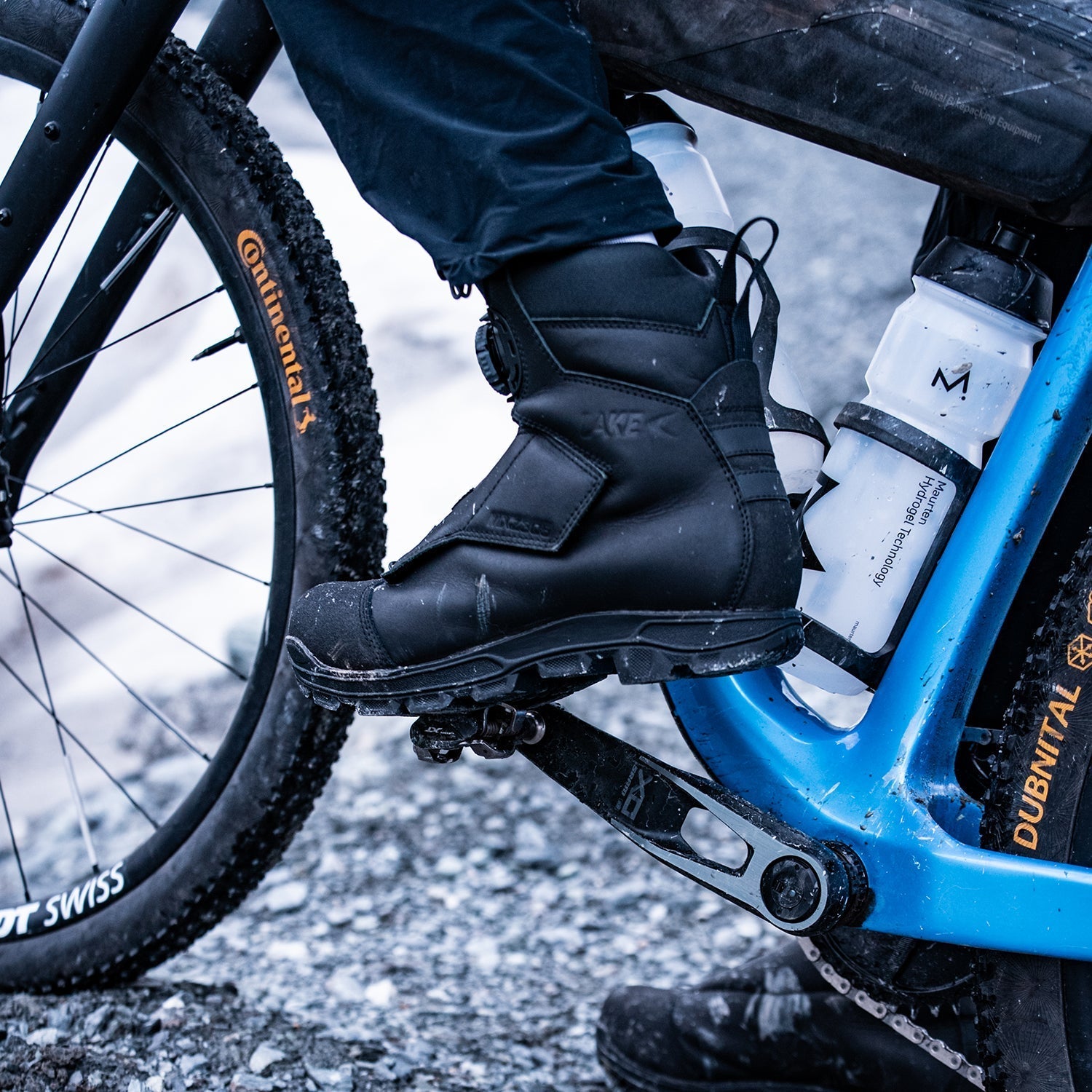
Cold Feet Will End a Ride Faster Than Tired Legs
Every winter cyclist knows the feeling. Twenty minutes from home, the temperature drops, and your toes start to go. First they sting, then they ache, then they disappear entirely. By the time you turn for home you are not training, you are surviving, and you are counting down the kilometres until you can feel your feet again.
Your hands have gloves. Your body has layers. But your feet sit at the front of the bike, low to the ground, clipped to a metal pedal that pulls heat straight out of the sole. They take the wind, the road spray, and the cold all at once. Standard cycling shoes are built with mesh panels and vents to keep summer feet cool, which is exactly the wrong design in January.
A proper winter cycling shoe solves this. Lake has been building cold-weather cycling footwear since 1997, when our original MXZ300 winter boot set the template the whole category still follows. This guide covers our current winter range, how to choose between the models, and how to size and layer them so your feet stay warm from the first pedal stroke to the last.
Winter Shoes or Overshoes: Which Do You Need?
The most common question we get is whether a dedicated winter shoe is worth it, or whether overshoes pulled over your summer shoes will do the job. The honest answer depends on how cold it gets and how often you ride.
Overshoes are a sensible entry point. They block wind and some spray, they pack down small, and they cost a fraction of a dedicated boot. In mild winter conditions, or for the occasional cold ride, a good pair of overshoes over your normal shoes is enough. The limitation is that they only add a thin wind-blocking layer. The shoe underneath is still a vented summer shoe with no insulation, and water that gets past the overshoe stays trapped against your foot.
Dedicated winter shoes are the answer once the cold becomes regular rather than occasional. They combine three things an overshoe cannot: genuine insulation built into the upper, a water-resistant construction, and a high cuff that seals the gap at the ankle where cold air and spray normally get in. For anyone riding through a real winter, week in and week out, a dedicated boot is the difference between dreading the cold and ignoring it.
Many of our riders run both: overshoes for the shoulder-season days that are merely chilly, and a Lake winter boot for the deep-winter stretch when it genuinely matters.
What Makes a Winter Cycling Shoe Different
A winter shoe is not just a normal shoe with a thicker sock stuffed inside. Four things set it apart.
Insulation. Our winter shoes use 3M Thinsulate, a synthetic insulation that traps body heat without adding bulk. Bulk is the enemy in a cycling shoe: too much padding and you lose the snug fit that keeps power transfer efficient. Thinsulate keeps the warmth and keeps the profile slim.
Water-resistant construction. Winter riding is wet riding. Our winter shoes use water-resistant membranes, DWR (durable water repellent) coatings, and sealed constructions designed to keep road spray and rain out far longer than a standard shoe. A quick note on honesty here, because it matters: no cycling shoe is fully waterproof. Every clipless shoe has an opening at the ankle, and given enough time in heavy rain, water finds a way in from the top. We describe our winter shoes as highly water-resistant, not waterproof, and in a downpour we still recommend pairing them with overshoes.
A high, sealed ankle. Standard cycling shoes stop at or below the ankle bone. Our winter models rise higher and seal closer to the leg, closing the gap that lets cold air and water funnel straight onto your foot. This single feature does more for warmth than almost anything else.
Glove-friendly closure. Adjusting a tiny dial or threading a lace with thick winter gloves is miserable. Most of our winter range uses the BOA M4 dial, a larger cartridge dial designed to be gripped and turned with gloved hands. If you want the full breakdown of closure systems, see our guide to BOA dials versus laces.
Lake's Winter Cycling Shoe Range
We build four winter shoes, each tuned for a different rider and a different level of cold. Here is how the range breaks down.
Lake CX146
The road rider's winter boot.
The CX146 is our winter shoe for road cyclists. It takes a 3-bolt road cleat, so it works with your existing road pedals, and it brings genuine cold-weather protection to the road position. Inside is Thinsulate insulation; outside is a water-resistant membrane and a DWR-treated upper that sheds spray and light rain. The BOA M4 dial adjusts easily even in full-finger gloves, and the high cuff seals out the cold.
Specs:
- Nylon composite sole tuned for cold-weather road riding
- 3-bolt road cleat compatible
- 3M Thinsulate insulation
- Water-resistant membrane with DWR-coated upper
- Glove-friendly BOA M4 dial
- High, sealed ankle cuff
- Built on our Sport Last
- Available in Regular and Wide
- Sizes 36-48
Best for: Road cyclists who want to keep riding their road pedals through the cold and wet months without their feet paying the price. The Wide option means broader feet stay warm without compression, which matters more in winter when circulation is already working against you.
Lake MX146
The all-terrain winter workhorse.
The MX146 is the off-road and commuting counterpart to the CX146. It shares the same Thinsulate insulation, water-resistant construction, and glove-friendly BOA M4 dial, but it takes a 2-bolt SPD cleat and adds a real rubber outsole with our ICE LOCK tread. Those anti-slip lugs grip frozen ground, wet leaves, and icy car parks, so you stay upright when you put a foot down. This is the shoe for winter commuters, gravel riders, and anyone who rides off the tarmac through the cold season.
Specs:
- Nylon composite sole with real rubber Enduro outsole
- ICE LOCK anti-slip tread lugs
- 2-bolt SPD cleat compatible
- 3M Thinsulate insulation
- Water-resistant construction with DWR-coated upper
- Glove-friendly BOA M4 dial
- High, sealed ankle cuff
- Built on our Sport Last
- Available in Regular and Wide
- Sizes 36-48
Best for: Winter commuters, mountain bikers, and gravel riders who need grip when walking on frozen or slick surfaces. The most versatile shoe in our winter range, and our most popular winter model alongside the CX146.
Lake MXZ305
For the harshest conditions you can ride in.
When the cold gets serious, this is the shoe. The MXZ305 is the fifth generation of the original Lake winter boot, a design we have been refining since 1997. It pairs Thinsulate insulation with a full-grain leather upper and a leather overflap that seals the closure against driving wind and spray. Leather is the unsung hero of a deep-winter boot: it naturally resists wind and water and holds warmth in a way synthetic uppers struggle to match. The MXZ305 is built for the days most riders stay home.
Specs:
- Nylon composite sole with real rubber Enduro outsole
- 2-bolt SPD cleat compatible
- 3M Thinsulate insulation
- Full-grain leather upper with sealing leather overflap
- Glove-friendly BOA M4 dial
- High, sealed ankle cuff for maximum coverage
- Available in Regular width
- Sizes 38-48
Best for: Riders facing genuine deep-winter cold, long hours in low temperatures, and the worst of the wet and wind. This is our warmest, most protective shoe. Note that the MXZ305 comes in Regular width only; riders who need a wider winter fit should look at the CX146, MX146, or MXZ21, all available in Wide.
Lake MXZ21
The lightweight, athletic winter shoe.
Not every winter ride is a slog through freezing rain. Some are hard training efforts on cold but dry days, and for those the MXZ21 is ideal. It is the lightest and most performance-oriented shoe in our winter range, built around a carbon fibre midsole for genuine power transfer and a soft-shell upper with a DWR coating that blocks wind and sheds light moisture. A speed-lace closure keeps the weight down and the profile clean. Think of it as a winter shoe that still wants to go fast.
Specs:
- Carbon fibre midsole for efficient power transfer
- Real rubber outsole
- 2-bolt SPD cleat compatible
- Soft-shell upper with DWR coating
- Speed-lace closure system
- Available in Regular and Wide
- Sizes 38-48
Best for: Performance-minded riders who train through winter, who want a lighter and stiffer shoe than a full insulated boot, and who ride more in the cold-and-dry than the cold-and-soaked. The carbon midsole sets it apart from the rest of the winter range, which use nylon composite soles tuned for warmth over stiffness.
How to Choose the Right Winter Shoe
Four shoes, four jobs. Here is how we would steer you.
If you ride road and want to keep your road pedals: the CX146. It is the only winter shoe in our range with a 3-bolt road cleat.
If you commute, ride gravel, or ride off-road in winter: the MX146. The ICE LOCK tread and SPD cleat make it the do-everything winter shoe, and it is the one most riders should start with.
If you face genuine deep-winter cold and wet: the MXZ305. Leather upper, leather overflap, maximum protection.
If you train hard through winter and want a lighter, stiffer shoe: the MXZ21. The carbon midsole and lower weight make cold-weather efforts feel less like a penalty.
If you have wider feet: the CX146, MX146, and MXZ21 all come in Wide. Winter is the worst time to ride a shoe that is even slightly too tight, because compression cuts circulation exactly when you need it most. See our wide cycling shoes collection for the full picture.
How to Size Winter Cycling Shoes
This is the single most important thing to get right, and it is where most riders go wrong. Lake recommends sizing up one to one and a half sizes in winter shoes.
Why? Warmth in cold conditions comes from two things: insulation and air circulation. A winter shoe that fits like a summer shoe leaves no room for a thicker winter sock, and worse, it compresses your foot and cuts off the blood flow that actually keeps it warm. A slightly roomier winter shoe lets you wear a proper winter sock and leaves a small pocket of air that your body heat warms and the insulation traps. Tight equals cold. A little room equals warm.
Measure your feet using our size guide, then add a size to a size and a half for your winter pair. If you are between sizes, round up. This is the opposite of how we advise sizing our road and MTB shoes, where a precise, snug fit is the goal, so do not assume your winter size matches your summer size.
A Word on Water Resistance
We want to be straight with you, because overpromising here ruins rides. Our winter shoes are highly water-resistant, not waterproof. The membranes, DWR coatings, and sealed constructions will keep your feet dry through spray, slush, and light to moderate rain for a long time. But every clipless cycling shoe has an opening at the ankle, and in sustained heavy rain, water eventually works its way in from the top, runs down your leg, and pools inside.
The fix is simple: in a genuine downpour, pull a pair of overshoes over your winter boots. The shoe handles insulation and the bulk of the water resistance; the overshoe handles the top-down soaking. Together they keep you dry far longer than either alone. And after a wet ride, dry your shoes properly, which brings us to the last point.
Caring for Winter Shoes
Winter shoes work hard and take abuse from salt, grit, and water. Keep them performing:
- Dry them slowly and naturally. Stuff them with newspaper after wet rides to draw out moisture, and let them air-dry away from direct heat. Never put them on a radiator or in a dryer; high heat damages adhesives, membranes, and leather.
- Wipe off road salt. Salt is corrosive and dries out leather and fabric. A quick wipe-down after winter rides makes a real difference over a season.
- Re-treat the DWR. The water-repellent coating wears off over time. A wash-in or spray-on DWR refresher once or twice through the winter restores the water resistance.
- Condition the leather. The MXZ305's leather upper stays supple and water-resistant longer with an occasional light leather treatment.
Frequently Asked Questions
What are the best winter cycling shoes?
For most riders, the Lake MX146 is the best all-round winter cycling shoe: insulated, water-resistant, glove-friendly, and grippy enough to walk on ice thanks to its ICE LOCK tread. Road riders who want to keep their road pedals should choose the CX146, and riders facing the most severe cold should choose the leather MXZ305.
Should I buy winter cycling shoes or overshoes?
For occasional cold rides or mild winters, overshoes over your normal shoes are a sensible and affordable choice. For regular winter riding, dedicated winter shoes are far warmer because they combine built-in insulation, water-resistant construction, and a sealed ankle that overshoes cannot match. Many riders own both and use overshoes on top of winter shoes in heavy rain.
Are Lake winter cycling shoes waterproof?
They are highly water-resistant, not waterproof. The membranes and DWR coatings keep your feet dry through spray and light to moderate rain, but no clipless cycling shoe is fully waterproof because of the opening at the ankle. In sustained heavy rain, pair your winter shoes with overshoes.
What size winter cycling shoes should I buy?
Size up one to one and a half sizes from your normal Lake size. The extra room lets you wear a thicker winter sock and leaves a pocket of air that keeps your foot warm. A winter shoe that fits tight will cut your circulation and leave you with cold feet. Check our size guide for measuring instructions.
Can I use winter cycling shoes on an indoor trainer?
We do not recommend it. Winter shoes are insulated to trap heat, which is exactly what you do not want indoors, where there is no wind chill. Your feet will overheat. Use your normal road or MTB shoes for trainer sessions and save the winter boots for outdoor rides.
Are winter cycling shoes available in wide fit?
Yes. The CX146, MX146, and MXZ21 all come in Regular and Wide. The MXZ305 comes in Regular only, though its high-volume construction and recommended sizing up give a roomier fit than a standard shoe. Riders with wide feet should also read our guide to cycling shoes for wide feet.
What is the warmest Lake winter cycling shoe?
The MXZ305 is our warmest and most protective winter shoe, built for the harshest conditions with a full-grain leather upper, a sealing leather overflap, and Thinsulate insulation. It is the fifth generation of our original winter boot, a design we have refined since 1997.
Do I need different winter shoes for road and mountain biking?
It depends on your cleats. The CX146 takes a 3-bolt road cleat for road pedals; the MX146, MXZ305, and MXZ21 take a 2-bolt SPD cleat for mountain bike and gravel pedals. Choose the winter shoe that matches the pedal system you already ride.
Ready for winter? Browse the complete winter cycling shoes collection, check our size guide for winter sizing, or read our guide to choosing cycling shoes if you are weighing up which type of shoe is right for you.
Best Gravel Cycling Shoes 2026
Cycling Shoe Stiffness Explained